
Prison isn’t just a place of punishment-it’s a place where people live, often for years. And what happens inside those walls shapes what happens outside. If all you do is lock someone up, you’re not fixing anything. You’re just delaying the problem. But when prisons combine education, therapy, and work into one coordinated system, something powerful happens: people change. And they don’t go back.
Why Siloed Programs Fail
For decades, correctional facilities treated mental health, addiction, education, and job training like separate boxes. You’d get therapy on Mondays, GED classes on Wednesdays, and a janitorial job on Fridays. No one talked to each other. No one coordinated. And it showed in the numbers. Nearly two out of three people released from prison are back behind bars within three years. That’s not a coincidence. It’s a system failure. The truth? People don’t have just one problem. They have many. A man might struggle with depression, have a 10-year heroin habit, never finished high school, and has no idea how to apply for a job. Treating just one of those things doesn’t fix the rest. That’s why integrated rehabilitation works better than anything tried before.How Integration Works in Practice
Think of it like a team. A counselor, a teacher, and a job coach all work together on the same person. They share notes. They adjust goals. They don’t wait for the next class or the next appointment. They talk daily. This is what happens in real integrated programs. In one county jail program studied over 30 months, 261 inmates with both mental illness and substance use disorders entered a program where therapists trained in co-occurring disorders (COD) provided treatment. They didn’t just hand out pills or assign homework. They built routines. They helped people manage triggers. They practiced job interviews. And they kept working with them after release. The result? Those who attended more sessions were less likely to return to jail. Every extra session mattered. Even with short stays-most were released within 8 weeks-there was a clear pattern: more contact = less recidivism.The Role of Education: More Than Just a GED
Education isn’t about making inmates smarter. It’s about making them feel capable. When someone learns to read at 25, write a resume at 30, or balance a budget at 35, it changes their identity. They stop seeing themselves as “inmates” and start seeing themselves as “students,” “workers,” “fathers.” Studies show that inmates who complete even basic education reduce their chance of returning to prison by up to 43%. But it’s not just about diplomas. It’s about learning how to learn. How to show up on time. How to follow instructions. How to ask for help. These are the skills that keep people out of trouble after release. And it’s not just academic. Vocational training in carpentry, welding, culinary arts, or IT support gives people real options. One man in Oregon learned to install solar panels in prison. After release, he got hired by a green energy company. He’s now a supervisor. He pays taxes. He supports his kids. That’s not a miracle. That’s a program that worked.Therapy That Actually Sticks
Therapy in prison doesn’t mean sitting in a room with a counselor once a week. The most effective programs are group-based, structured, and consistent. Therapeutic communities-where inmates live together in a unit designed around recovery and mutual accountability-have shown the clearest results. In one facility, a therapeutic community unit had 31 misconduct charges over two years. Every other unit had more than double that. Officers reported fewer fights. Inmates said they felt safer. They trusted staff more. Why? Because the environment was built on conversation, not control. People talked. Staff listened. Problems were solved together. And it’s not just about addiction. Trauma, anger, anxiety-all of it gets addressed. One woman in California told researchers she’d never talked about the abuse she suffered as a child until she entered the program. She didn’t get “cured.” But she learned to cope. And that made all the difference.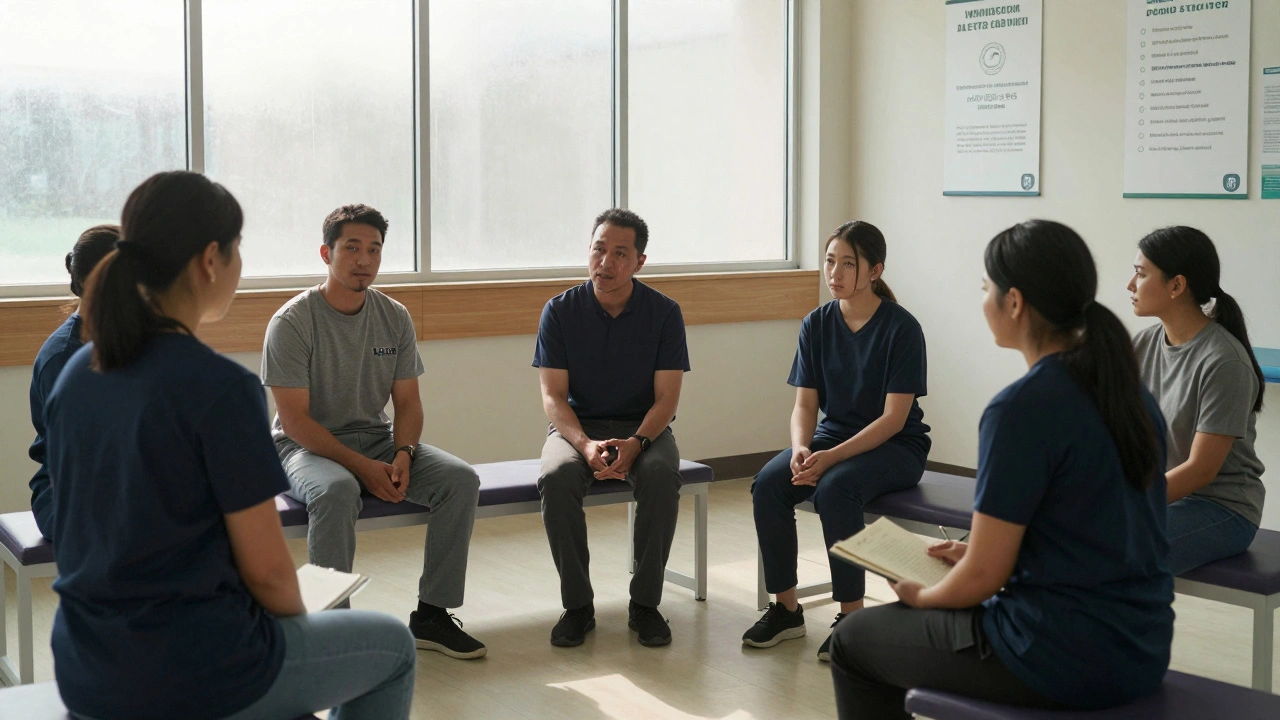
Work: The Missing Piece
Work isn’t a privilege. It’s therapy. It’s structure. It’s dignity. Inmates who work inside prison are 13% less likely to reoffend. Why? Because work teaches responsibility. It builds routine. It gives purpose. And it creates a resume. But not all prison jobs are equal. Cleaning toilets or folding laundry doesn’t prepare someone for life outside. The best programs offer real, marketable skills. A man who learns to code in prison can get hired as a junior developer. A woman who runs a kitchen in prison can become a sous-chef. These aren’t fantasies. These are real outcomes. And here’s the kicker: every inmate who participates in a well-run program saves taxpayers about $5,675 in avoided incarceration costs. That’s not a guess. That’s from a Canadian study. The math is clear: invest in rehabilitation, and you save money. Not just emotionally. Financially.Who Benefits the Most?
Not everyone responds the same way. Research shows that rehabilitation works best for people whose risk level has been properly assessed. That’s where tools like the Level of Service/Case Management Inventory (LS/CMI) come in. The LS/CMI looks at things like criminal history, substance use, employment, family ties, and-critically-procriminal attitudes. People with high scores in procriminal thinking? They don’t respond well to standard programs. They need something different. More intense. More personalized. That’s why blanket programs fail. You can’t give the same class to someone who’s never held a job and someone who’s committed violent crimes for years. The best programs match people to the right intervention. High-risk? More therapy. Low-risk? More job training. The goal isn’t to fix everyone the same way. It’s to fix the right thing for the right person.What Happens After Release?
Rehabilitation doesn’t end when the gate opens. That’s when it really begins. In the jail program mentioned earlier, 52% of participants went on to community-based treatment after release. That’s higher than most programs achieve. Why? Because they didn’t just hand them a pamphlet. They connected them. They called ahead. They arranged rides. They made sure someone was waiting on the other side. Probation officers who got special training reported something surprising: their caseloads dropped. And that made everything better. With fewer people to manage, they could actually build relationships. They helped with food, housing, childcare, mental health appointments. The result? Fewer violations. Fewer returns to jail. One probationer said, “My officer didn’t just check on me. He asked if I had a place to sleep.” That’s not supervision. That’s humanity.
The Bigger Picture
The United Nations Office on Drugs and Crime (UNODC) says countries should shift from punishment to rehabilitation. Why? Because prisons that focus on healing are safer-for everyone. Staff report fewer assaults. Inmates report feeling safer. Families report fewer disruptions. Communities report less crime. In juvenile facilities, after implementing integrated safety and health programs, complaints from youth dropped to zero per 100 staff days. Assaults on staff fell. Solitary confinement use dropped. Kids said they felt 33% safer. This isn’t soft on crime. It’s smart on crime. You don’t stop crime by locking people up. You stop it by giving them a reason to stay out.What’s Holding Us Back?
The biggest barrier isn’t money. It’s mindset. Too many still believe punishment is the only answer. But the data doesn’t lie. Programs that combine education, therapy, and work reduce recidivism by about 9 percentage points. That’s a 20% drop in reoffending rates overall. Some programs fail because they’re too short. Eight weeks isn’t enough to heal trauma or learn a trade. Others fail because staff aren’t trained to work together. Or because the system still treats inmates like problems to manage-not people to rebuild. The solution isn’t complicated. It’s consistent. It’s intentional. It’s about treating people like they matter.Real Change, One Person at a Time
There’s no magic bullet. But there is a path. And it starts when a prison stops being a warehouse and starts being a place of growth. One man, after 12 years inside, finished his associate’s degree in prison. He took a welding course. He went to therapy twice a week. He got a job offer before he was even released. He’s now a foreman. He volunteers at a youth center. He says, “I didn’t just get out. I got back.” That’s what integrated rehabilitation does. It doesn’t promise perfection. It doesn’t erase the past. But it gives people a chance to build something new.Do rehabilitation programs really reduce recidivism?
Yes. Research shows that inmates who participate in well-designed rehabilitation programs reduce their chances of reoffending by about 9 percentage points within three years of release. This effect is strongest when programs are integrated-combining education, therapy, and work-and when they’re matched to the individual’s risk level using tools like the LS/CMI.
What’s the most effective type of rehabilitation program?
Therapeutic communities have shown the strongest results in reducing misconduct and recidivism. These are prison units where inmates live together in a structured environment focused on recovery, accountability, and peer support. Staff are trained to build relationships, not enforce rules. Inmates report feeling safer and more supported. Programs that combine this model with education and job training see even better outcomes.
Why do some inmates not benefit from rehabilitation?
Inmates with very high risk scores-especially those with strong procriminal attitudes-often don’t respond to standard programs. Their mindset resists change. The key is matching them to more intensive, specialized interventions. Blanket programs for everyone fail. The most effective systems use assessments like the LS/CMI to tailor interventions to each person’s needs.
Is integrated rehabilitation expensive?
No-it saves money. A Canadian study found that for every offender who completed a rehabilitation program, the system saved about $5,675 in avoided incarceration costs. While upfront costs exist, they’re far lower than the cost of re-arresting, re-trialing, and re-incarcerating someone. Plus, rehabilitated individuals are more likely to work, pay taxes, and support their families.
Can rehabilitation work in short-term jails?
It’s harder, but still possible. One study found that even with average stays of just 8 weeks, inmates who attended more therapy sessions were less likely to return to jail. The challenge is continuity. Programs need to connect inmates with community services before release. Without that link, gains made in jail often disappear quickly.
Do these programs help staff too?
Absolutely. Staff in facilities with integrated programs report fewer fights, less use of force, and better relationships with inmates. In juvenile facilities, staff assaults dropped after implementation. When inmates are engaged in meaningful programs, the entire environment becomes safer and calmer-for everyone.
What role does education play beyond getting a GED?
Education rebuilds identity. Learning to read, write, or solve math problems gives inmates confidence. But more importantly, it teaches discipline, persistence, and problem-solving-skills that matter in jobs and relationships. Vocational training in fields like welding, IT, or culinary arts gives them real career paths. A GED opens the door. A trade keeps them from turning back.
Are these programs only for men?
No. While much of the early research focused on men, programs for women show similar success. Women often enter prison with histories of trauma, addiction, and poverty. Integrated programs that address these root causes-especially through therapy and job training-have led to significant drops in recidivism among female inmates. Gender-responsive design matters, but the core model works for all.
What’s the biggest mistake correctional systems make?
Treating rehabilitation as a side program instead of the main goal. Many facilities offer programs, but they’re underfunded, inconsistently staffed, and disconnected from each other. The real mistake is believing that punishment alone prevents crime. The data proves otherwise. Integration, consistency, and individualized planning are what work-not isolation or neglect.
Can this model work in rural or underfunded prisons?
Yes, but it requires creativity. You don’t need fancy labs or big budgets. You need trained staff who collaborate. A single counselor who works with a teacher and a job coach can create real change. Partnerships with local colleges, nonprofits, and businesses can fill gaps. The key is not scale-it’s coherence. Even small, well-coordinated efforts can reduce recidivism.