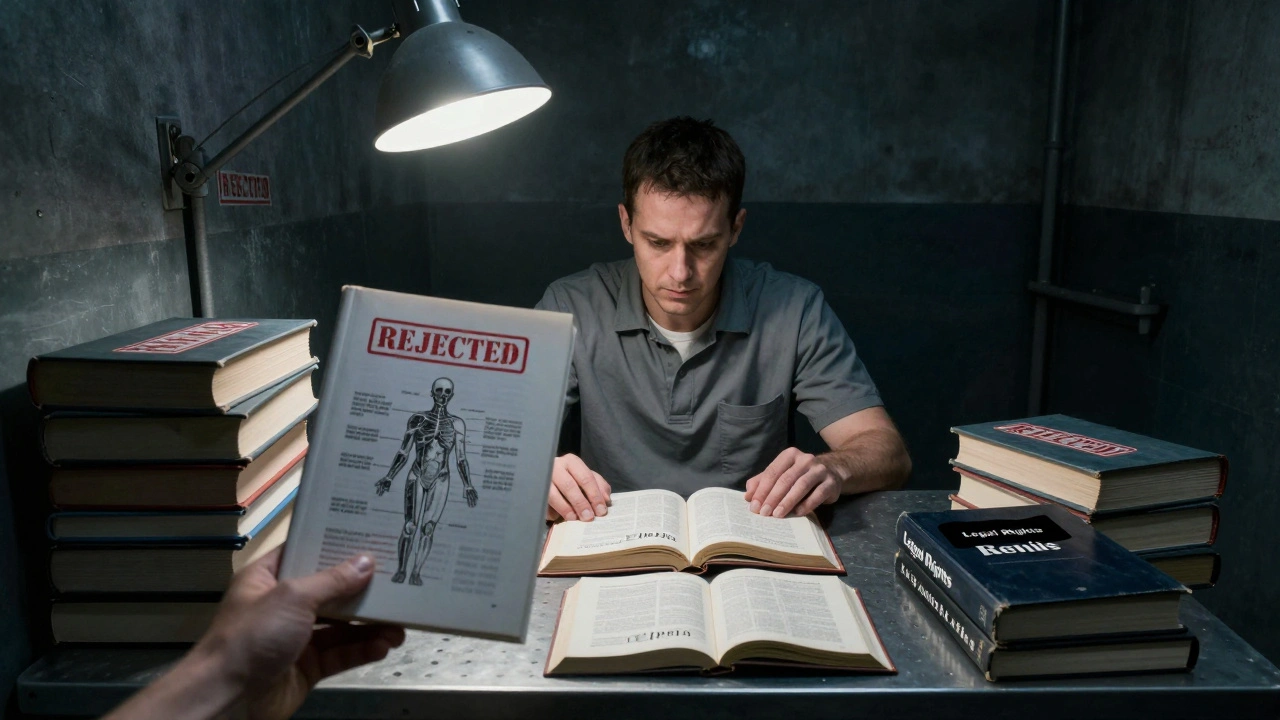
When you’re locked up, the law doesn’t disappear - but your ability to understand it often does. Prisons in the U.S. claim they restrict reading materials to keep facilities safe. But what happens when the materials being banned are legal guides, medical dictionaries, or even art books that help someone understand their rights? The answer isn’t just about books. It’s about whether people behind bars can fight for their freedom, defend themselves in court, or even learn how the system works. And right now, that access is being systematically cut off.
What Gets Banned - And Why
It’s not just novels or gang-related magazines that get thrown out. According to PEN America’s 2024 report, prisons are banning medical textbooks, dictionaries, legal manuals, and even children’s books. The reason? "Sexually explicit." That label gets slapped on anything with nudity - even anatomical diagrams in a medical textbook, drawings of the human body in an art class, or a photograph of a breastfeeding mother in a public health pamphlet. One prison in Florida banned a book on diabetes because it had a picture of a woman in a swimsuit. Another banned a dictionary because it included the word "penis." These aren’t isolated cases. In 2021 alone, Florida banned 22,825 titles. Texas banned over 10,000. Kansas, 7,700. But those numbers are just what got recorded. Most states don’t track bans at all. So the real number? Likely far higher. And it’s not just books. Letters from lawyers, court documents, and even handwritten notes from family members are opened, read, and sometimes withheld. Only four states - Arkansas, Georgia, Michigan, and Texas - treat legal mail as privileged. Everywhere else, prison staff can open it, copy it, or delay it indefinitely. No warrant. No judge. Just a guard’s decision.The Vendor Lock-In: A New Kind of Censorship
You might think if a book isn’t banned, you can just order it. But here’s the twist: in 84% of prisons, you can’t order from just any publisher or bookseller. You have to buy from a state-approved vendor. And those vendors? They’re chosen behind closed doors. No public list. No application process. No appeal if your book gets rejected. Idaho started this policy in 2020. In the first year alone, they blocked one book for every four incarcerated people. That’s not about security. That’s about control. Even if a book is perfectly legal, if the vendor doesn’t have approval, it never makes it to your cell. And because these vendors rarely carry legal resources - especially ones published by nonprofits or legal aid groups - people are left without the tools they need to navigate the courts. The Thurgood Marshall Civil Rights Center says this violates the Fourteenth Amendment. Denying access to certain books based on who sells them? That’s discrimination. And it’s especially damaging for people trying to file appeals, challenge their sentences, or understand parole rules.How the Law Has Changed - And Why It Matters
In 1974, the Supreme Court ruled in Procunier v. Martinez that prisons could only censor mail if it threatened security - and even then, they had to prove it. But in 1977, the Court flipped the script in Jones v. North Carolina Prisoners’ Labor Union. Now, it’s not the prison’s job to justify the ban. It’s the person locked up who has to prove the ban is unnecessary. That’s a massive shift. Before, prisons had to show a real threat. Now, they just say "it might cause trouble" - and that’s enough. No evidence needed. No hearing. No lawyer. Just a stamp: "Rejected. Security reason." This legal change made it nearly impossible to challenge censorship. Inmates don’t have lawyers. They don’t have internet. And they can’t easily file paperwork. So most just give up. And the censorship keeps growing.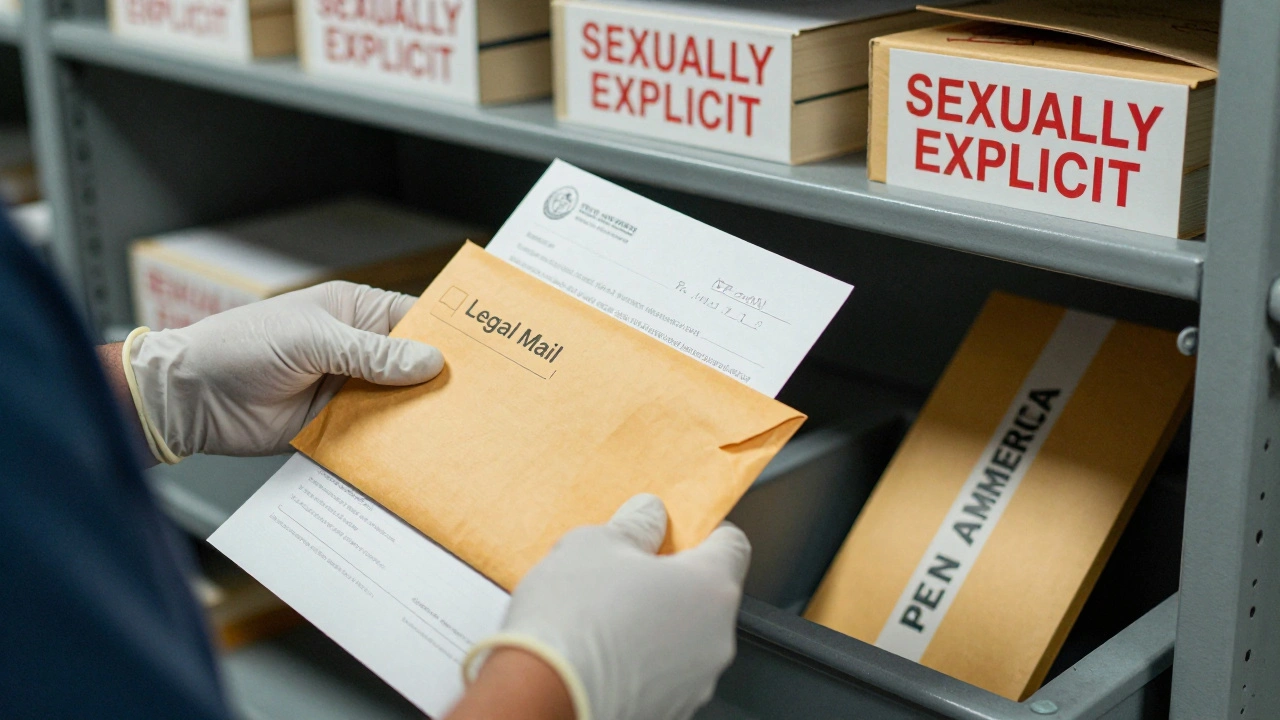
Legal Information Isn’t Just Books - It’s Communication
The problem isn’t limited to paper. Phone calls are recorded. Emails are scanned. Video visits are monitored. Even letters to journalists are censored. Out of 50 states and the federal system, 14 ban inmates from getting paid for journalism. Nineteen more limit it. That means if you write about abuse in prison, you can’t be paid for it. You can’t publish it. You can’t even get help from a reporter who wants to tell your story. The Prison Journalism Project has documented dozens of cases where inmates were punished for writing about guards, medical neglect, or overcrowding. One man in California was put in solitary for sending a letter to a newspaper about his cellmate’s suicide. Another in Ohio had his legal appeal delayed for six months because his letter to a nonprofit legal aid group was "under review." These aren’t exceptions. They’re policy.The Human Cost: When You Can’t Understand the Law
Imagine you’re serving time. You believe your trial was unfair. You want to appeal. But you can’t read the legal code because your copy of Black’s Law Dictionary was banned for "inappropriate content." You don’t know how to fill out the forms. You can’t find help. You don’t have a lawyer. So you write your own motion. But you miss a deadline. Your appeal gets thrown out. That’s not hypothetical. That’s happened - over and over. People in prison are the only group in America who are legally entitled to legal resources - and yet, the system makes it nearly impossible to get them. No access to case law. No access to legal aid pamphlets. No access to court forms. No access to even a dictionary. And then, when they fail in court, they’re told: "You should’ve known better." It’s a trap. And it’s intentional.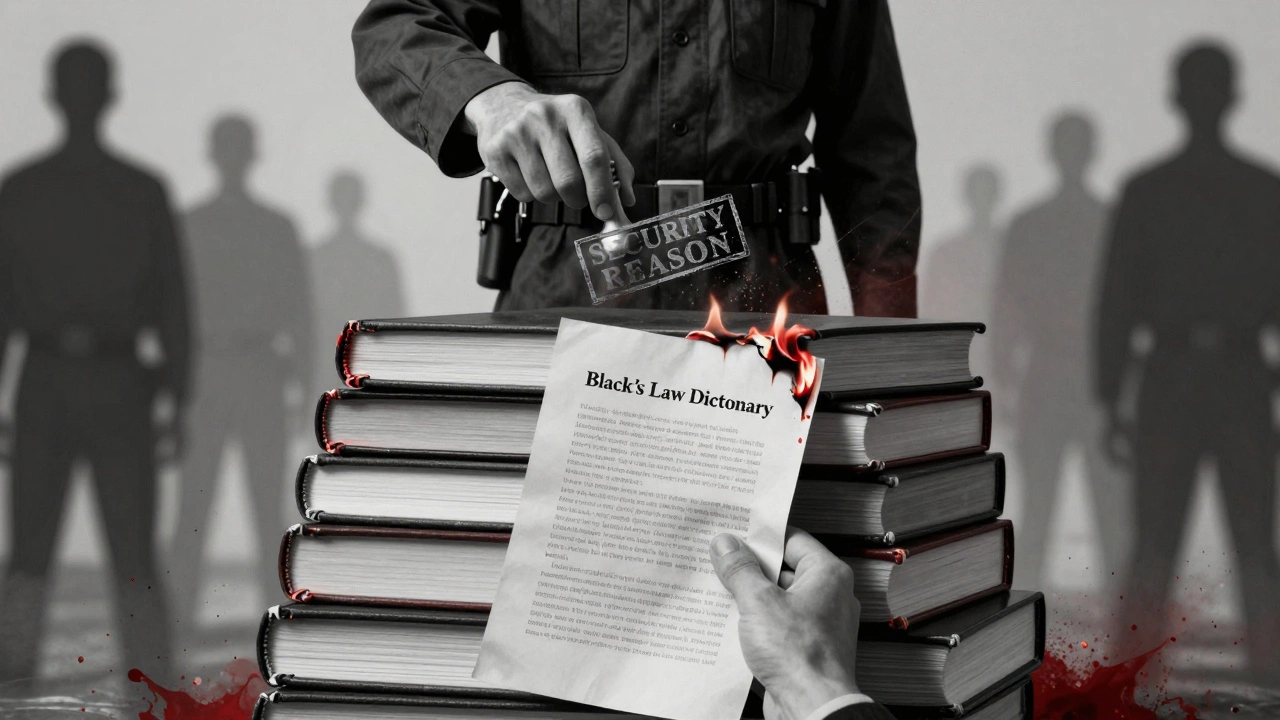
Why This Isn’t Just About Safety
Prison officials say censorship keeps things secure. But what’s more dangerous - a book on civil rights, or a guard who can abuse power without accountability? What’s more dangerous - a letter from a journalist, or a system that hides abuse behind closed doors? Bestselling author Robert Greene, whose books are banned in 19 states, calls it "the ultimate form of power manipulation." He’s right. Totalitarian regimes don’t just ban books. They control who can sell them. Who can write them. Who can read them. And who gets punished for trying. Prisons don’t need to ban every book. They just need to make it so hard to get the right ones that people stop trying. That’s the goal. And it’s working.What’s Being Done - And What Needs to Change
Advocacy groups like PEN America and the Marshall Project are pushing back. They’ve collected data on banned books, exposed vendor policies, and pressured lawmakers. Some states have started reviewing their lists. Florida removed 2,000 titles after public outcry. But that’s just a drop in the ocean. Real change needs four things:- End content-neutral bans. No more banning books because they’re too thick, or the paper is too white, or the cover is too colorful.
- Open vendor lists. If a publisher wants to sell to prisons, they should be able to apply - and know why they’re rejected.
- Protect legal mail. All correspondence with lawyers, courts, and legal aid organizations should be treated as privileged - no opening, no copying, no delay.
- Train staff. Mailroom workers need to understand the First Amendment. Not just the rules - the rights.
What You Can Do
If you care about justice, this matters. Legal access isn’t a privilege. It’s a right. And when you take it away from people in prison, you weaken the whole system. Support organizations that send books to inmates. Donate to legal aid groups that help incarcerated people file appeals. Pressure your state representatives to audit prison censorship policies. Ask: "How many books were banned last year? Why? Who decided?" Because if we let this continue, we’re not just censoring books. We’re censoring justice.Can prisons legally ban legal books?
Yes - but only under very limited conditions. Courts have ruled that prisons can restrict materials if they pose a legitimate threat to security. However, banning legal guides, dictionaries, or court forms under vague terms like "sexually explicit" or "too large" has been challenged as unconstitutional. The Thurgood Marshall Civil Rights Center argues these practices violate the Equal Protection Clause of the Fourteenth Amendment because they deny incarcerated people fair access to legal resources.
Why are dictionaries banned in prisons?
Dictionaries have been banned for reasons like containing words deemed "inappropriate" or because they were printed on paper with a color prison staff didn’t like. More commonly, they’re flagged under "sexually explicit" - for example, if a dictionary includes the word "penis" or "vagina." This is part of a broader pattern where reference materials essential for legal self-representation are censored under misleading or arbitrary labels.
Can incarcerated people sue over censorship?
Technically yes - but it’s extremely difficult. Since the 1977 Jones v. North Carolina ruling, the burden of proof has shifted. Inmates must now prove that a censorship policy is unnecessary, rather than the prison proving it’s necessary. Without legal representation, access to legal materials, or the ability to file paperwork, most people can’t mount a challenge. Courts rarely intervene unless there’s a clear constitutional violation, which is hard to prove under current standards.
Do prisons censor mail from lawyers?
In 46 states and the federal system, prison staff can open and read legal mail. Only four states - Arkansas, Georgia, Michigan, and Texas - treat it as privileged communication. Even in those states, mail can be searched for contraband, but not read. This means in most places, confidential attorney-client communications are not protected, violating the Sixth Amendment right to counsel.
How do single-vendor policies limit legal access?
Single-vendor systems mean prisons only allow books from one approved seller. These vendors rarely stock legal materials from nonprofit publishers, legal aid groups, or state bar associations. Even if a book is not banned, if the vendor doesn’t carry it - or if the vendor was denied approval - the book can’t be ordered. This creates a bottleneck that effectively bans entire categories of legal resources, especially those published by grassroots organizations.