
Every year, thousands of people enter U.S. prisons without a high school diploma. For many, this isn’t just a gap in their resume-it’s a barrier to survival after release. Without basic education, finding a job, housing, or even a driver’s license becomes harder. That’s why correctional facilities across the country offer GED and Adult Basic Education (ABE) programs. These aren’t optional extras. They’re mandatory, structured, and tied directly to early release credits under federal law.
Who Must Take the GED in Prison?
If you’re sentenced to a federal prison and don’t have a verified high school diploma or GED, you’re required to enroll in an education program within 60 days of arrival. This rule applies to all security levels-from maximum-security lockups to minimum-security camps. The same goes for many state systems, including Colorado and others that follow federal guidelines. Even if you’ve never opened a textbook, you’re still eligible. There’s no minimum education level to start.The system doesn’t wait. Upon intake, staff check your records through the Bureau of Prisons’ SENTRY system. If no diploma or GED shows up, you’re automatically placed on a waiting list for classes. Priority goes to those with the soonest release dates. But everyone gets in eventually. The law says so.
Adult Basic Education: The First Step
Not everyone starts at the same place. Some inmates read at a third-grade level. Others can’t do basic math. That’s where Adult Basic Education (ABE) comes in. ABE isn’t a separate program-it’s the foundation. Before you can even touch GED materials, you must prove you’re ready.Testing happens early. If your reading and math scores are below an eighth-grade level, you’ll spend weeks or months in ABE. You’ll learn fractions, sentence structure, vocabulary, and how to follow written instructions. It’s not remedial-it’s essential. Without these skills, passing the GED is nearly impossible.
For non-English speakers, the path is different. If you speak little or no English, you’re placed in English as a Second Language (ESL) classes. You stay there until you hit CASAS Level C-the equivalent of eighth-grade English. Only then do you move into GED prep. This ensures you’re not just memorizing test answers-you’re learning to understand them.
What’s in the GED Curriculum?
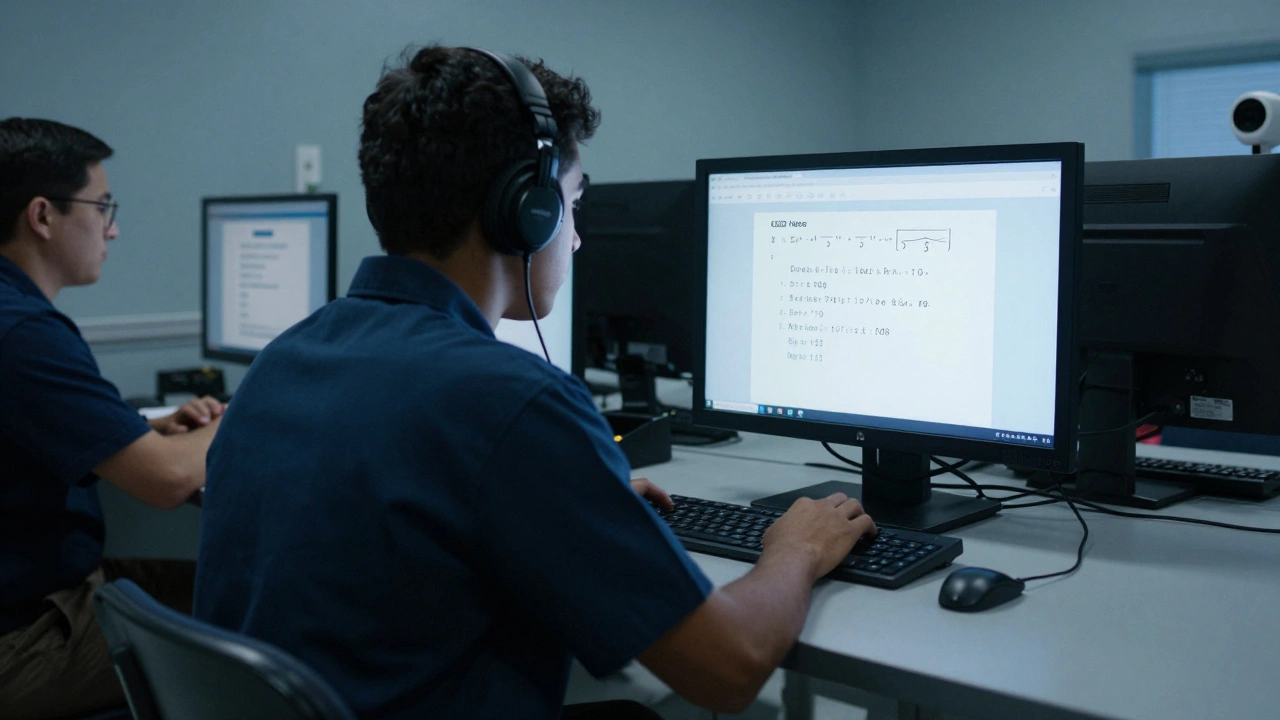
The GED test has four parts: Reasoning Through Language Arts, Mathematical Reasoning, Science, and Social Studies. That’s it. No fluff. No extra subjects. The prison curriculum mirrors exactly what’s on the official test.Classes meet daily, usually for 1.5 hours or more. Teachers are certified-many hold state teaching licenses. In Colorado, educators must be credentialed by the Department of Education. Instruction isn’t just lectures. You’ll use tablets, computers, and software like Edmentum or PLATO for personalized practice. These platforms adapt to your pace. Struggling with decimals? The system gives you more drills. Nailing science? You move ahead faster.
Special education accommodations are available. If you have a documented learning disability, you get extra time, readers, or modified materials under IDEA and Section 504. You’re not behind because you’re different-you’re supported because the system has to be fair.
How Do You Pass?
To earn your GED, you must score at least 145 on each of the four modules. That’s out of 200. It’s not easy, but it’s doable. Many inmates pass on their first try. In fact, pass rates in prison programs often match or exceed those in community adult education centers.You can take the test in English or Spanish. You can even mix languages-pass one module in English, another in Spanish-and still get one credential. The test is administered on-site by certified examiners. No internet? No problem. The GED Testing Service software works offline. Practice tests and full exams are downloaded onto secure prison computers.
If you fail one section? You don’t get kicked out. You get help. More tutoring. More practice. Then you retest. There’s no limit to how many times you can try. The goal isn’t to punish-it’s to prepare.
What Happens After You Pass?
When you pass all four modules, you get a GED credential issued by the GED Testing Service. For federal inmates, the issuing jurisdiction says “District of Columbia”-no matter where you took the test. That credential is recognized by every state, college, and employer in the U.S. It’s not a second-class diploma. It’s a real high school equivalency.But the GED is just the start. Many prisons now link GED completion to career training. In Colorado, you can’t even apply for apprenticeships or job programs like the Ironworkers Union’s Gladiator Program unless you have your GED. That program teaches welding, safety, and job readiness at five minimum-security facilities. It’s hands-on. It pays. And it’s only open to those who’ve earned their credential.
Other programs offer computer science, entrepreneurship, budgeting, and conflict resolution. These aren’t just feel-good activities. They’re job skills. Studies show inmates who earn a GED are 43% more likely to find employment after release-and their chances of returning to prison drop by nearly 30%.

Why This Matters Beyond the Walls
This isn’t about being nice. It’s about public safety. The First Step Act of 2018 turned GED completion into an official Evidence-Based Recidivism Reduction program. That means every inmate who earns a GED earns extra time off their sentence-up to 15 days per month of participation. That’s not a reward. It’s an incentive built on data.And the data doesn’t lie. Federal Bureau of Prisons reports show that inmates with a GED are far more likely to hold steady jobs, support their families, and avoid reoffending. In Colorado, over 80% of inmates who complete GED and vocational training stay out of prison after release. Compare that to less than 40% for those who don’t.
Who Gets Exempted?
You don’t have to take the GED if you already have a high school diploma or GED. That’s simple. But what if you lost your diploma? You can submit a transcript, a letter from your old school, or even a notarized statement. The system has ways to verify.Pretrial inmates and those in study or observation status can be exempted if they prove they already have a credential. But if you can’t prove it? You’re enrolled. No exceptions. Even if you’re only in jail for a few months, if you don’t have a diploma, you’ll be placed in a class.
Some inmates get stuck in lower custody levels because they haven’t completed literacy requirements. That means fewer privileges, less freedom, and limited job assignments. Getting your GED isn’t just about your future-it changes your daily life right now.
What’s Missing? What’s Next?
Not every prison has enough teachers. Some have waiting lists that stretch for months. Not every facility has tablets or reliable computers. Funding gaps still exist. But the system is designed to work. It’s just not perfect.If you’re incarcerated and want to start, talk to the education director. Ask for your placement test. Ask about waiting lists. Ask what career programs you can join after you earn your GED. Don’t wait. The clock is ticking-not just for your sentence, but for your future.
Every GED earned in prison is a step away from the cycle. It’s not magic. It’s work. And it works.
Do I need a high school diploma to enroll in a GED program in prison?
No. You don’t need any prior education to enroll. The GED program is designed for people who never finished high school. If you don’t have a diploma or GED, you’re required to start-even if you can’t read at a high school level. Adult Basic Education (ABE) helps you build up to the GED.
Can I take the GED test in Spanish while in prison?
Yes. The GED test is available in both English and Spanish. You can take different modules in different languages-for example, take the math test in Spanish and the language arts test in English-and still earn one official GED credential. This is especially helpful for non-native English speakers.
How long does it take to get a GED in prison?
It varies. If you test at or above eighth-grade level, you could finish in 3-6 months with consistent attendance. If you start in Adult Basic Education or ESL, it could take 6-18 months. The law requires at least 240 hours of instruction, but most inmates take longer to build skills and pass all four test sections.
What happens if I fail one part of the GED test?
You don’t lose your chance. You get more instruction and then retest. Most prisons offer free remediation classes after a failed module. You can retake the test as many times as needed. There’s no limit, and there’s no penalty-just more support.
Does earning a GED in prison reduce my sentence?
Yes, under the First Step Act. Inmates who complete GED and other evidence-based programs earn time credits toward early transfer to prerelease custody or supervised release. For every 30 days of participation, you can earn up to 15 days off your sentence. GED completion is the most common program used for this credit.
Can I use my GED to go to college after release?
Absolutely. The GED is legally equivalent to a high school diploma. Every public and private college in the U.S. accepts it for admission. Many prisons even partner with community colleges to help inmates enroll in courses before release. Your GED opens doors to financial aid, scholarships, and vocational training programs.
Are GED programs available in all prisons?
Yes. All federal prisons and most state facilities offer GED and Adult Basic Education programs. Some have waiting lists due to staffing or space limits, but no inmate who qualifies is permanently denied. Priority is given based on release date, but everyone eventually gets access.