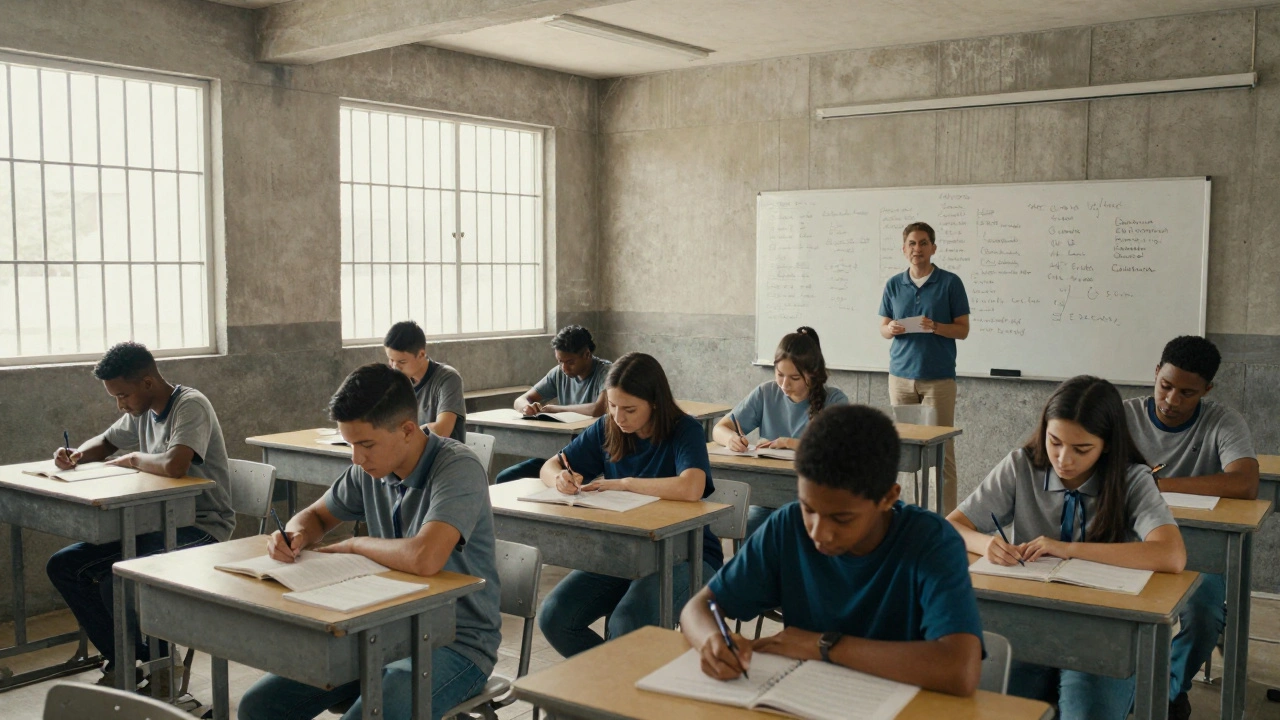
The Money Behind the Classroom
When you think about college, you probably picture lecture halls, campus libraries, and student loans. But inside a correctional facility, the classroom looks very different. There are no open campuses or casual coffee runs between classes. Instead, there are security protocols, restricted technology access, and a complex web of funding that keeps the lights on and the books flowing. If you’ve ever wondered how incarcerated students actually pay for their degrees, the answer isn’t simple. It’s a patchwork quilt made of federal aid, private donations, state budgets, and sheer institutional grit.
For decades, this system was barely visible. Then came a massive shift in policy. Today, we’re looking at a new era where federal dollars are finally reaching behind bars, but only if you know where to look. Let’s break down exactly who is paying for prison education, how the money moves, and why it still falls short.
The Return of the Pell Grant
The biggest change in recent history is the return of Pell Grants, which are federal need-based financial aid awards that were restored to incarcerated students after a 30-year ban. For thirty years, from 1994 to 2020, Congress blocked these grants for anyone in prison. That meant if you wanted to get an education while incarcerated, you had to rely on charity or pay out of pocket-a nearly impossible task for most people.
That changed on December 27, 2020, when Congress passed the FAFSA Simplification Act. This law amended the Higher Education Act of 1965, effectively restoring eligibility. But here’s the catch: the restoration didn’t happen overnight. The provisions officially took effect on July 1, 2023. Before that permanent fix, there was a pilot program called the Second Chance Pell Experiment, which was a Department of Education pilot launched in 2015 to test the feasibility of providing federal aid to incarcerated students. Between 2016 and 2022, this experiment helped about 12,000 students earn credentials. It proved that giving money to prisoners worked-they graduated, they got jobs, and they stayed out of prison. That data paved the way for the full restoration.
So, can every prisoner get a Pell Grant now? Not quite. The grant is tied to enrollment in an approved Prison Education Program (PEP), which requires specific institutional approval, reporting requirements, and oversight by the U.S. Department of Education. As of early 2024, very few programs have received this formal approval. This creates a bottleneck. You might be eligible on paper, but if your facility doesn’t have an approved PEP, you can’t access the money. It’s like having a ticket to a concert but being locked outside the venue.
| Year | Event | Impact |
|---|---|---|
| 1994 | Pell Grant Ban Begins | Federal aid removed for incarcerated students |
| 2015 | Second Chance Pell Pilot Launches | Tests viability of federal aid in prisons |
| 2020 | FAFSA Simplification Act Passed | Legally restores Pell eligibility permanently |
| 2023 | Restoration Takes Effect | Grants available via approved PEPs only |
The Power of Philanthropy
If federal grants are the backbone, philanthropy is the muscle. Foundations step in to fill the gaps that government money leaves behind. The biggest player here is the Andrew W. Mellon Foundation, which has committed over $60 million to prison education initiatives since 2015, focusing on arts and humanities. They aren’t just writing checks; they’re building infrastructure. In 2023 and 2024 alone, they announced another $5 million in grants spread across seven colleges and nonprofits.
Where does this money go? It funds things Pell Grants don’t cover. Think paid internships for incarcerated students, academic conferences held inside prisons, and open-source learning management systems designed specifically for secure facilities. For example, Unlocked Labs received funding to expand its open-source learning management system tailored for prison education programs. This tech helps instructors deliver content without needing high-speed internet or unrestricted computer access, which are often banned in prisons for security reasons.
Mellon also launched "Imagining Freedom," a $125 million initiative aimed at tackling mass incarceration more broadly. But within that, their focus remains sharp: supporting humanities-based courses and degrees. Why humanities? Because critical thinking, writing, and empathy are skills that help reduce recidivism. These grants allow institutions to hire faculty, buy materials, and provide support services without draining their own budgets.
State Budgets and Institutional Costs
Let’s talk about the elephant in the room: state corrections budgets. Ideally, states would fund education as part of their rehabilitation mission. In reality, it’s complicated. Some states allocate specific dollars for prison education, but many do not. When state money is scarce, universities themselves often absorb the cost. This is known as institutional funding. A university might run a prison program as part of its community engagement mission, using general funds to cover tuition and staff salaries.
However, this model is fragile. Research from New England Higher Education (NEBHE) shows that the actual cost of running a prison education program consistently exceeds available funding. Here’s why: security protocols require extra staffing. You need compliance officers, security liaisons, and specialized instructors who can navigate the rules. Technology is limited, so you might need offline servers or printed materials instead of cheap digital textbooks. Student support services-like counseling and tutoring-must be adapted to the carceral environment.
Even with Pell Grants covering up to $3,395 per student for the 2023-24 academic year, that amount only covers 40% to 60% of the true delivery costs. The rest has to come from somewhere. If the foundation grants dry up, or if the university faces budget cuts, the program disappears. This scarcity-driven model means programs are always competing for survival, rather than focusing solely on student success.
The Role of Volunteers
You won’t see much data on volunteers in official reports, but they are everywhere. Nonprofit organizations like the Prison Education Foundation rely heavily on volunteer contributions for tutoring, mentorship, and program administration. Without them, many programs couldn’t function. Volunteers provide hours of service that would otherwise cost thousands of dollars in staff time. They tutor math, help with essay writing, and offer mentorship during reentry.
But relying on volunteers has risks. It’s unpredictable. People move, get busy, or burn out. A program can’t build a five-year curriculum around volunteer availability. While their passion is invaluable, it doesn’t replace the need for stable, paid positions. The goal should be to use volunteers to enhance the experience, not to subsidize basic operational costs indefinitely.
A Real-World Example: Cal Poly Humboldt
To see how all this works together, look at Cal Poly Humboldt. In fall 2024, they launched the first Department of Education-approved PEP offering Pell Grants at a high-security facility: Pelican Bay State Prison. This wasn’t just any program; it was a bachelor’s degree in communications. How did they pull it off? They combined federal Pell eligibility with strong institutional commitment and likely supplemental grant funding. They started small-with just 16 students in January 2024-and scaled up as approvals came through. This case study proves that federally funded, high-level education is possible even in maximum-security settings, provided the administrative hurdles are cleared.
Barriers to Access
Despite the progress, barriers remain high. The National Association of Student Financial Aid Administrators (NASFAA) and the State Higher Education Executive Officers (SHEEO) point out that cross-sector collaboration is key. Colleges and corrections agencies don’t always speak the same language. Policy obstacles, funding silos, and implementation delays hinder participation. For instance, getting a PEP approved takes time. During that wait, students miss out. And even after approval, not every inmate can participate due to security classifications or space constraints.
Also, consider the geography. Most PEPs are in urban areas or near large universities. Rural prisons often lack access. This creates an equity issue where some incarcerated people have opportunities while others don’t, based purely on location.
Can all incarcerated students get Pell Grants?
No. Pell Grants are only available to students enrolled in an approved Prison Education Program (PEP). As of 2024, only a small number of facilities have received this approval from the U.S. Department of Education. If your facility doesn’t have a PEP, you cannot access the grant, even though you are legally eligible.
Who pays for prison education if not the inmates?
The cost is shared among four main sources: federal Pell Grants, philanthropic foundations (like the Mellon Foundation), state corrections budgets, and the parent higher education institution itself. Often, these sources only cover 60-80% of the total cost, leaving a gap that must be filled by additional grants or institutional subsidies.
What is the Second Chance Pell Experiment?
It was a pilot program launched by the Department of Education in 2015 to test providing federal financial aid to incarcerated students. It ran until 2022 and helped about 12,000 students earn credentials. Its success led to the permanent restoration of Pell Grant eligibility in the FAFSA Simplification Act of 2020.
Why do prison education programs cost more than regular college?
Prison programs face unique expenses: security personnel, compliance officers, restricted technology infrastructure, specialized instructional methods, and adapted student support services. These factors increase the per-student cost significantly compared to traditional campus settings.
How can I find out if my prison offers Pell-eligible programs?
You should contact the education coordinator at your facility or check the U.S. Department of Education’s list of approved Prison Education Programs (PEPs). Since approvals are ongoing, the list changes regularly. Your local library or nonprofit partners may also have updated information.