
Facing a constitutional violation while incarcerated can feel like shouting into a void. Whether it is a denial of medical care, excessive force, or systemic discrimination, the legal path to accountability is steep and filled with procedural traps. However, the law provides specific mechanisms for prisoners to sue government officials. The most powerful tool in this arsenal is civil rights lawsuits from prison, which allow you to seek damages or force a change in prison conditions.
The process is rigorous. If you miss a deadline or skip a mandatory grievance step, a judge can dismiss your case before they even look at the facts. This guide breaks down the complex federal and state requirements into manageable steps, from documenting the incident to filing the final complaint.
Quick Summary: Essential Filing Facts
- Primary Law: Most state/local official suits use 42 U.S.C. § 1983; federal officials require a Bivens action.
- Prerequisite: You must usually "exhaust" all prison grievance procedures before heading to court.
- Costs: Most prisoners apply for In Forma Pauperis status to avoid paying the upfront filing fee.
- Documentation: Keep a detailed log of dates, badge numbers, and witness names immediately after an incident.
The Legal Foundation: Which Law Applies?
Before you put pen to paper, you need to know which legal theory supports your claim. You can't just sue because a guard was mean; you must allege a violation of a specific constitutional or federal right.
If you are suing state or local officials (like county sheriffs or state DOC employees), you will likely use 42 U.S.C. § 1983. This statute allows individuals to sue anyone acting "under color of state law" who deprives them of their constitutional rights. For example, if a guard denies you insulin, they aren't just being negligent-they are potentially violating your Eighth Amendment right against cruel and unusual punishment.
If the person who violated your rights is a federal employee (like a BOP officer), you use a Bivens action. While similar to Section 1983, Bivens is a judicial doctrine that is often narrower and harder to win, but it is your primary path for federal misconduct.
Depending on your state, you might also have state-level options. In California, the Bane Act (Civil Code § 52.1) provides a way to sue for interference with constitutional rights. If the issue is employment discrimination within the prison, the Fair Employment and Housing Act (FEHA) may apply.
The Critical First Step: Administrative Exhaustion
This is where most prisoner lawsuits fail. Before a federal court will even consider your case, you must prove you tried to solve the problem internally. This is called "exhausting administrative remedies."
In many jurisdictions, this means you must file a formal grievance, attend any required hearings, and follow the appeal process to the very end. For instance, in Virginia, skipping a single step in the jail's grievance process can lead to an immediate judicial dismissal. In Texas, you may need to exhaust both prison grievances and habeas review.
Some cases require an even earlier step. In California, if you intend to sue a public entity, you must file a "Government Claim" under the California Government Claims Act. This claim must be submitted within six months of the incident. If you wait longer, you may lose your right to sue entirely.
For specialized claims like employment discrimination, you might need to file with the Equal Employment Opportunity Commission (EEOC) or the California Civil Rights Department (CRD). In these cases, you cannot just file in court; you must first obtain a "Right-to-Sue" notice from the agency.
Gathering Evidence and Documentation
A judge doesn't want to hear that "everyone knows the guards are abusive." They want specific, concrete evidence. The strength of your case depends on what you record in the days and weeks following the violation.
Start a legal log immediately. Record the exact date, time, and location of the event. Don't just write "Officer Smith"; write "Officer Smith, Badge #1234." If there were witnesses, list their names and cell numbers. If you were injured, take photos if possible or request medical records that document the injuries.
Keep a paper trail. Save every grievance you filed and every response you received. If the prison claims they "lost" your grievance, keep a copy of the dated request you sent to the administration. This documentation proves that you attempted to exhaust your remedies and that the prison failed to act.
Preparing the Complaint
The "complaint" is the formal document that starts your lawsuit. Federal courts are very strict about how this is written. While you can handwrite it, it must be legible. Most courts prefer you use a standardized "Prisoner Civil Rights Complaint" form.
When filling out the form, focus on facts, not legal arguments. Instead of writing "The defendant violated the Eighth Amendment by being cruel," write "On April 10, Officer X punched me in the ribs while I was handcuffed." The judge determines the law; you provide the facts.
Organization is key, especially in the claims section (usually Part F). Use one paragraph for each separate legal claim. For example, if a guard beat you and then refused you medical care for the injuries, those are two different claims. One is an excessive force claim; the other is a deliberate indifference to medical needs claim. Give each its own paragraph.
| Requirement | Standard/Value | Note |
|---|---|---|
| Page Limit | Typically 25 pages | Exceeding this often requires special court permission. |
| Copies | 4 copies (Central Dist. CA) | Always check your local district's specific copy count. |
| Clarity | Concise facts | Avoid lengthy legal citations in the initial complaint. |
| Claim Structure | 1 paragraph per claim | Use numbered pages (e.g., 5-A, 5-B) for extra claims. |
Handling Filing Fees and In Forma Pauperis
Lawsuits are expensive. The standard filing fee in federal district courts is $350, and some districts add administrative fees. For most incarcerated people, this is an impossible sum. This is where In Forma Pauperis (IFP) status comes in.
Under 28 U.S.C. § 1915, you can ask the court to let you proceed without paying the fee upfront. To do this, you must provide a certified copy of your trust fund account statement for the six months immediately preceding the filing. A prison official must sign the certification section of your application.
Be aware that IFP is not a "free pass." If the court grants your request, they will typically deduct the filing fee from your trust fund in periodic installments. Even if the case is later dismissed as frivolous, the court can still collect the full fee from your account.
Finalizing and Filing the Case
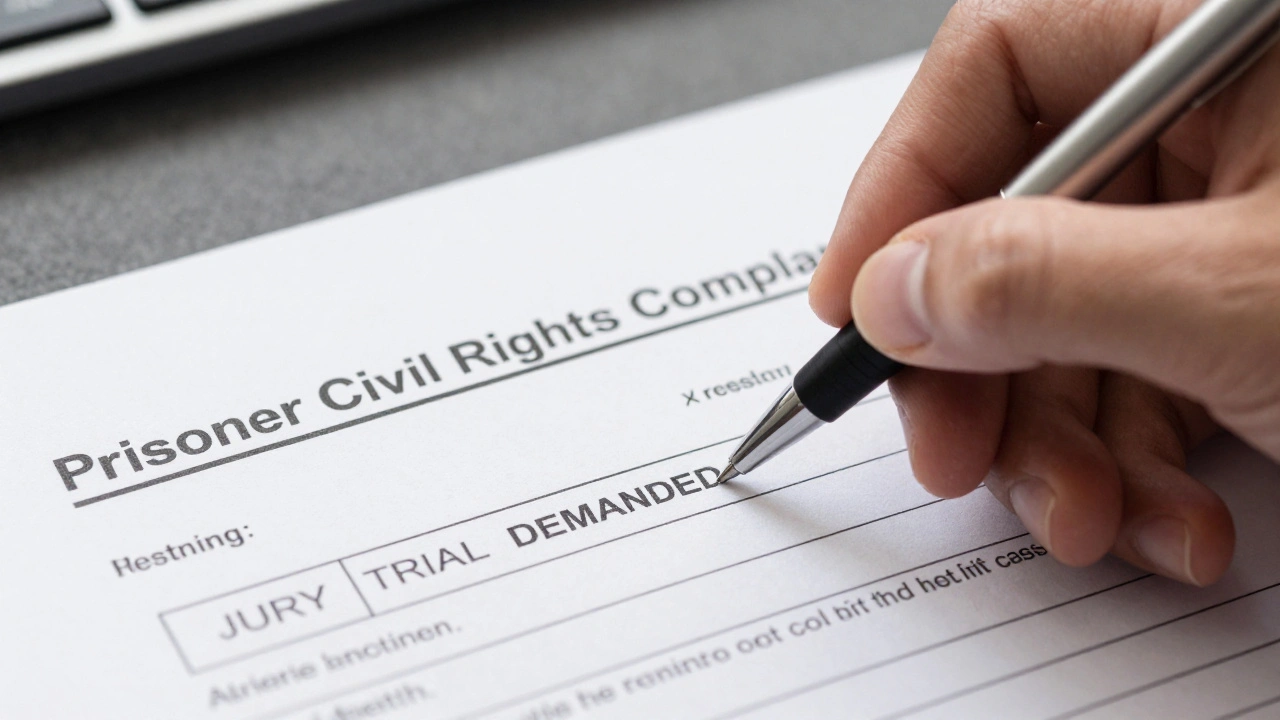
Before you send the packet, check for one critical detail: the jury trial demand. If you want a jury to decide your case, you must explicitly write "JURY TRIAL DEMANDED" in the designated space on the complaint form. If you forget this, you may waive your right to a jury trial entirely.
Decide where to file. If your claim involves federal laws or constitutional rights, go to federal court. If you are suing for a violation of state law, you may need state court. In some areas, like Virginia, the Prisoner Litigation Reform Act requires state suits to be filed in the specific city or county where your jail is located.
If you feel overwhelmed, look for a "Prisoner Self-Help Packet" from the district court. These packets contain the exact forms and instructions tailored to that specific court. Additionally, resources like the Jailhouse Lawyers Handbook provide an essential roadmap for those navigating the system without an attorney.
What happens if I file a lawsuit before finishing my grievances?
In most cases, the court will dismiss your lawsuit without prejudice, meaning you have to go back and finish the prison's administrative process before you can file again. This can waste months of time and potentially miss statutory deadlines.
Can I sue the prison as a whole or just the guards?
Under Section 1983, you generally sue individual officials. Suing a municipality or a government entity is much harder because of "qualified immunity" and other legal protections. You must usually prove that the violation resulted from an official policy or custom of the institution.
How long does it take for the court to respond?
It varies wildly. After filing, the court may first review your IFP application. If accepted, the court will serve the defendants. It can take several months before you receive a response or a summons for a hearing.
What is qualified immunity?
Qualified immunity protects government officials from liability unless their conduct violated a "clearly established" statutory or constitutional right. This means you have to prove not only that the right was violated, but that any reasonable officer would have known it was a violation.
Do I need a lawyer to file a civil rights claim?
No, you can file pro se (representing yourself). However, you will be held to the same legal standards as an attorney. This is why following the procedural steps and using self-help packets is so critical.
Next Steps for Different Situations
If you are in immediate danger: Standard lawsuits take too long. You may need to research "emergency motions for preliminary injunctions" to get the court to order immediate relief (like medical treatment).
If you have already been released: You can still file for past violations, but be mindful of the Statute of Limitations. Every state has a different deadline (some as short as one year) for when a lawsuit must be filed after the incident.
If your case is dismissed: Read the judge's order carefully. If the judge dismissed the case "without prejudice," you can often fix the errors in your complaint and file an amended version.