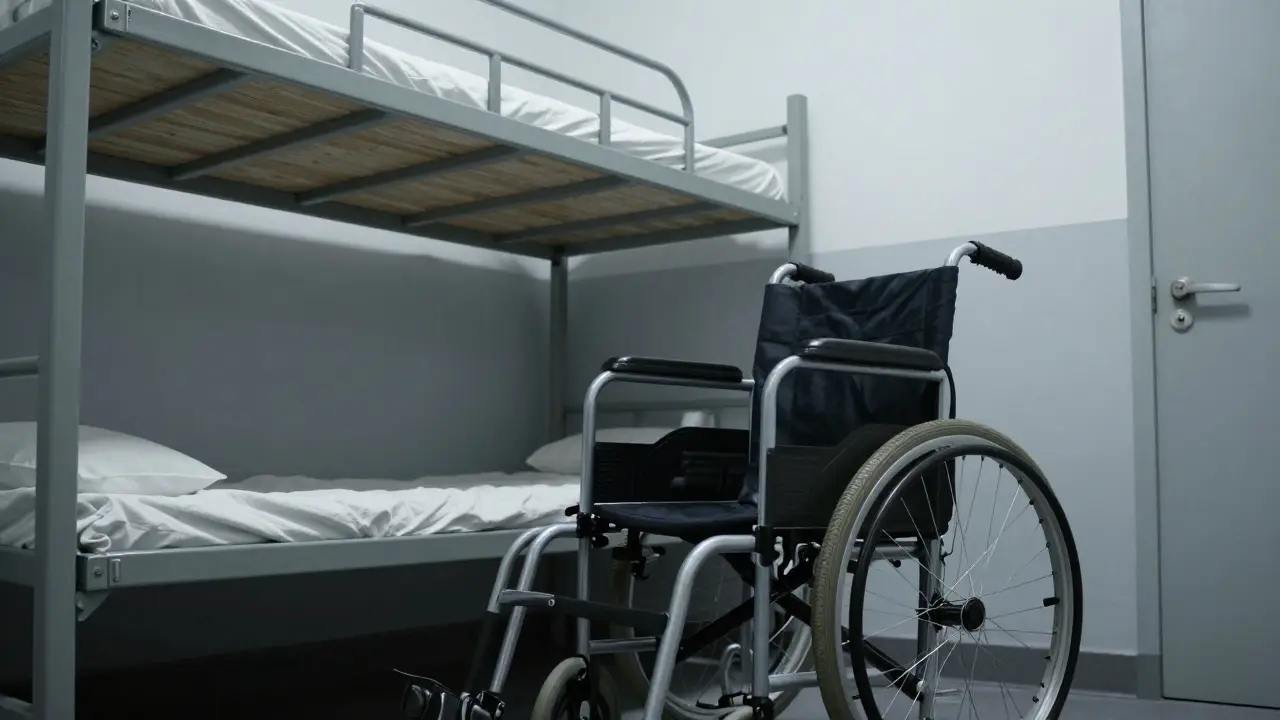
Imagine waking up in a cell where the bed is too narrow for your wheelchair, or trying to take medication that requires a specific timing schedule that conflicts with your facility’s rigid routine. For millions of people with disabilities entering the U.S. prison system, this isn't just an inconvenience; it's a daily barrier to basic survival. Yet, under federal law, these barriers are supposed to be non-existent. The intersection of disability accommodations and incarceration is one of the most complex areas of modern criminal justice, often overlooked by both policymakers and the public.
The core issue here is simple but profound: when a person loses their freedom, do they lose their rights? The answer, according to the Americans with Disabilities Act (ADA) and Section 504 of the Rehabilitation Act, is no. However, the gap between legal theory and prison reality remains wide. This guide breaks down what equipment, support systems, and legal protections actually exist for prisoners with physical, sensory, and cognitive disabilities. We will look at the specific hardware required, the staffing models needed, and the common pitfalls that lead to violations.
Legal Framework: What the Law Actually Requires
To understand why certain accommodations fail, you have to look at the two main pillars of protection. First is the Americans with Disabilities Act (ADA) a civil rights law prohibiting discrimination on the basis of disability. It applies to state prisons because they receive federal funding. Second is Section 504 of the Rehabilitation Act a federal statute ensuring equal access for individuals with disabilities in programs receiving federal financial assistance.
These laws don't just say "be nice." They mandate reasonable accommodations. This means if a prisoner needs a raised toilet seat to prevent injury, the prison must provide it unless doing so would cause an "undue hardship"-a high bar that usually involves significant financial cost or fundamental alteration of the program. In practice, this covers everything from communication aids for deaf inmates to dietary modifications for those with metabolic disorders.
A critical component is the Individualized Assessment. Unlike school IEPs, there isn't a standardized form for every prisoner. Instead, medical staff must evaluate each individual's specific needs upon intake and periodically thereafter. If this assessment is skipped or rushed, the foundation for proper care collapses immediately.
Essential Equipment for Physical Accessibility
When we talk about equipment, we aren't just talking about wheelchairs. We are talking about a suite of assistive technologies that allow independent living within a confined space. Here is what a compliant facility should ideally provide:
- Adaptive Wheelchairs: Standard wheelchairs often get stuck in narrow corridors. Facilities need lightweight, maneuverable chairs with anti-tip bars for stability on uneven surfaces.
- Accessible Beds: Beds must be height-adjustable to allow transfer from a wheelchair without lifting. Fixed-height bunks are a major violation point for mobility-impaired prisoners.
- Communication Devices: For hearing-impaired prisoners, this includes amplified phones, captioned televisions, and sign language interpreters during medical appointments.
- Sensory Aids: Large-print materials for low-vision inmates, tactile maps of the facility, and alert systems (like flashing lights for fire alarms) for those who cannot hear sirens.
- Caregiver Equipment: For severe cases, hoists for transferring patients and specialized mattresses to prevent pressure ulcers.
The maintenance of this equipment is just as important as its presence. A broken wheelchair in a prison is not just an inconvenience; it can immobilize a prisoner for days until repairs are made, leading to hygiene issues and loss of access to court dates or work details.

Staffing and Training: The Human Element
Equipment is useless if the staff doesn't know how to use it or respect the person using it. One of the biggest failures in prison health services is the lack of specialized training. Correctional officers (COs) are trained in security, not geriatrics or neurology. Medical staff are often general practitioners stretched thin across hundreds of patients.
Effective support requires a multidisciplinary approach. This includes:
- Primary Care Providers: Who manage chronic conditions and prescribe necessary adaptive equipment.
- Physical and Occupational Therapists: Who assess mobility limits and recommend specific modifications to cells or common areas.
- Psychologists: Who distinguish between behavioral issues and symptoms of cognitive disabilities like autism or traumatic brain injury.
- Case Managers: Who coordinate between medical, housing, and legal teams to ensure consistency in care.
Without regular interaction between these groups, information gets lost. A prisoner might tell the doctor they need a cane, but the housing unit chief never hears about it, resulting in a placement in a building with stairs only.
Common Barriers and Pitfalls
Why do accommodations still fail? Several structural issues persist. First is segregation. Many facilities house disabled prisoners in separate units, which can feel isolating and punitive rather than supportive. While sometimes necessary for safety, it often leads to less access to educational programs, jobs, and social interaction.
Second is the cost argument. Prisons operate on tight budgets. Management often argues that providing individualized equipment is too expensive. However, studies show that failing to provide adequate care leads to higher long-term costs due to worsened health conditions, lawsuits, and readmissions after release.
Third is advocacy fatigue. Prisoners often have to fight repeatedly for their rights. If a wheelchair breaks, they file a grievance. If it takes three weeks to fix, they file another. This cycle drains energy and trust in the system.
| Disability Type | Key Equipment Needed | Primary Staff Role | Common Failure Point |
|---|---|---|---|
| Mobility Impairment | Wheelchair, Transfer Hoist, Adjustable Bed | Occupational Therapist | Narrow doorways, delayed repairs |
| Hearing Loss | Amplified Phone, Captioned TV, Interpreter | Medical Coordinator | Lack of interpreter availability |
| Low Vision | Large Print Materials, Magnifiers, Tactile Maps | Rehabilitation Specialist | Poor lighting, small font sizes |
| Cognitive Disability | Simplified Instructions, Visual Schedules | Psychologist/Case Manager | Misdiagnosis as behavioral issue |
Best Practices for Effective Implementation
So, how do we fix this? Successful facilities focus on proactive rather than reactive measures. Intake screening should be comprehensive, involving direct conversation with the prisoner, not just reviewing old medical records. Facilities should maintain an inventory of common adaptive equipment to avoid long wait times for orders.
Another best practice is the creation of a Disability Liaison role. This person acts as a bridge between the inmate population and the administration. They handle grievances, track equipment repairs, and ensure that new policies are reviewed for accessibility impact before implementation.
Finally, feedback loops are essential. Regular surveys or meetings with prisoner representatives can highlight emerging issues before they become lawsuits. Transparency builds trust, and trust makes cooperation easier for everyone involved.
Frequently Asked Questions
Do prisoners have the right to keep their own personal assistive devices?
Generally, yes, provided the device does not pose a security risk. However, facilities often require inspection and may replace personal items with institutional ones for liability reasons. Prisoners should document any damage to their personal property.
What happens if a prison denies a reasonable accommodation?
The prisoner can file an internal grievance. If unresolved, they can file a lawsuit under the ADA or Section 504. Legal aid organizations often help with these cases. Denial without valid justification is a clear violation of federal law.
Are mental health conditions covered under disability accommodations?
Yes. Conditions like schizophrenia, bipolar disorder, and PTSD qualify. Accommodations might include quiet housing units, consistent medication schedules, or reduced noise exposure. The key is that the condition substantially limits a major life activity.
How often should disability assessments be updated?
There is no single federal rule, but best practice suggests annual reviews or whenever there is a significant change in health status. Chronic conditions may require more frequent monitoring to adjust equipment or care plans.
Does private prison management follow the same rules as state prisons?
Yes. Because they contract with government entities, they are subject to the same federal regulations. However, enforcement can be weaker due to contractual complexities, making advocacy even more critical in privately run facilities.