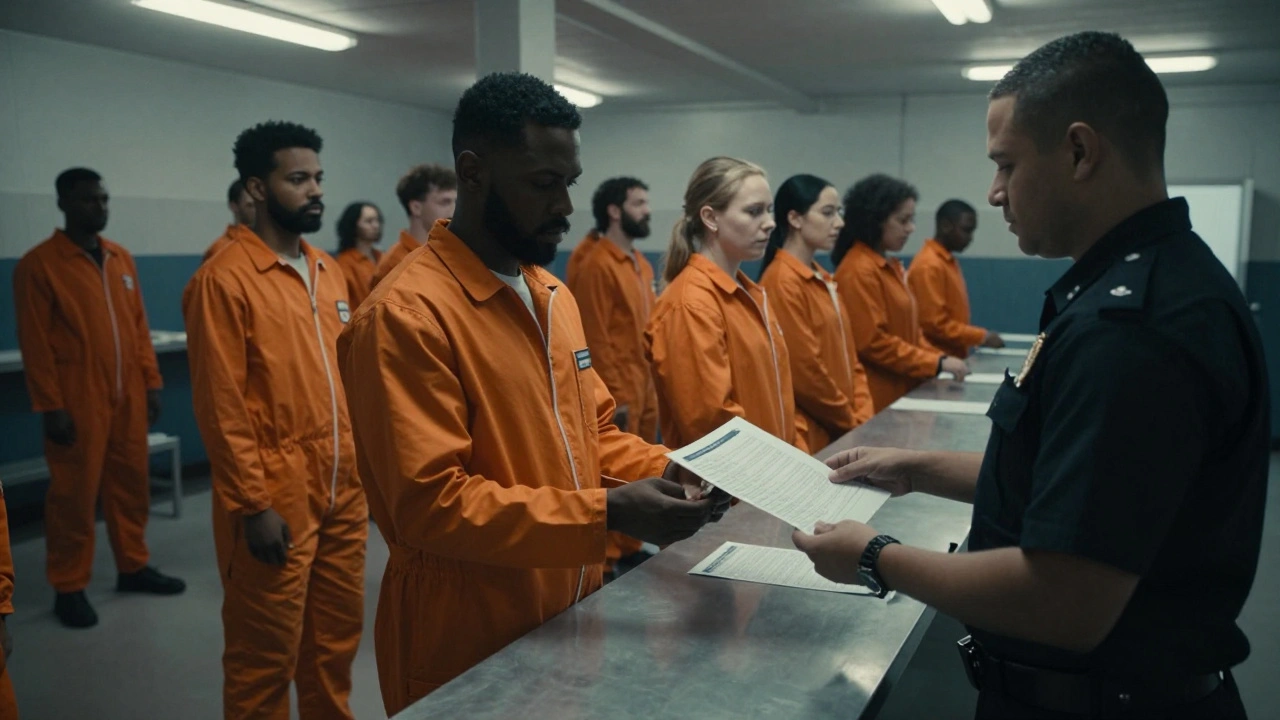
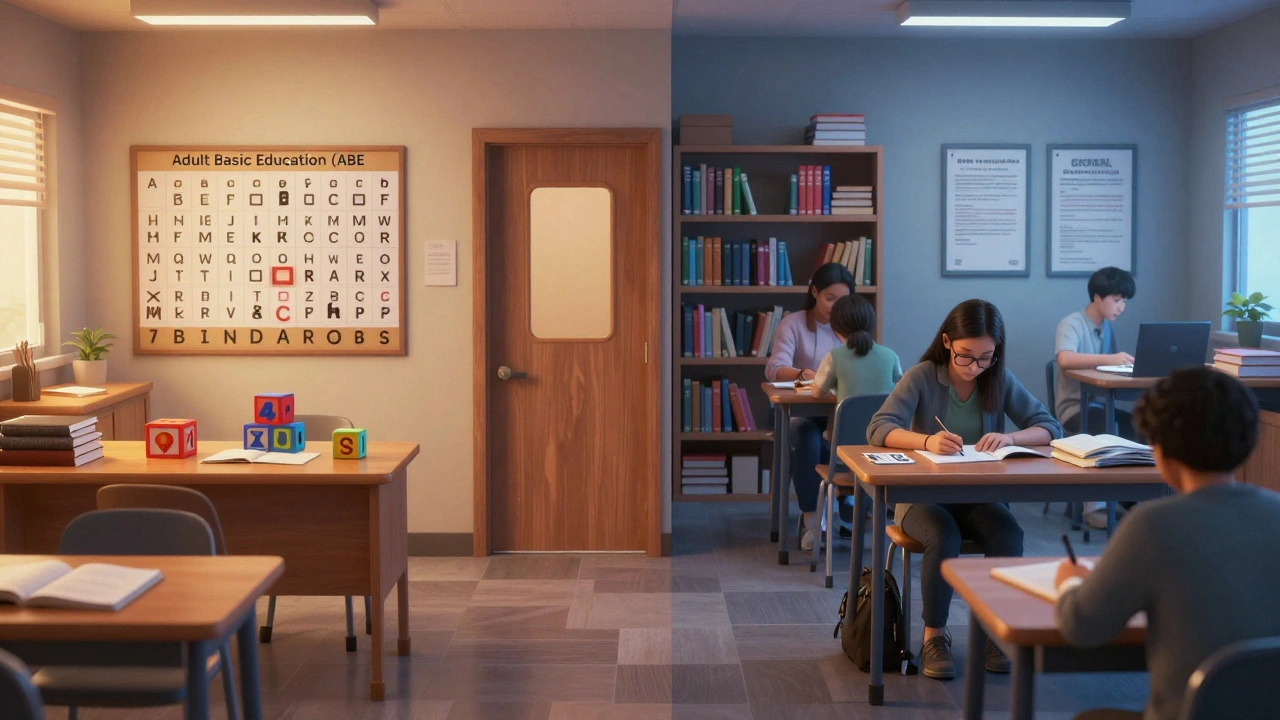
Imagine walking into a new prison with no high school diploma. Within days, you aren't just handed a cell key; you are handed a test. This isn't about punishment-it's about sorting. The system needs to know if you can read a work order, balance a ledger, or if you need help learning the alphabet. This process, known as educational placement, determines whether you enter Adult Basic Education (ABE) for foundational skills or jump straight into High School Equivalency prep.
For decades, this pathway was dominated by one name: the GED. Today, it’s a complex landscape involving multiple tests, strict grade-level thresholds, and significant logistical hurdles. Understanding how these systems work is crucial because getting placed correctly-and passing the final exam-can mean the difference between earning $0.40 an hour in the kitchen or $1.70 in a clerical role inside, and securing steady employment after release.
The Foundation: What Is Adult Basic Education (ABE)?
Adult Basic Education (ABE) serves as the entry point for incarcerated adults who lack basic literacy and numeracy skills. It is not a single class but a tiered system designed to bring students up to speed before they attempt any high-school-level coursework.
According to the U.S. Department of Education’s National Reporting System (NRS), ABE is divided into specific levels based on grade equivalents:
- ABE Level 1: Grade 0-1.9 (Basic non-readers)
- ABE Level 2: Grade 2.0-3.9
- ABE Level 3: Grade 4.0-5.9
In practice, this means if you score below an 8th-grade level on your intake test, you are often legally required to enroll in literacy programs. For example, the Federal Bureau of Prisons mandates that inmates testing below an 8.0 grade equivalent must complete at least 240 instructional hours of literacy training. In California, the CDCR places individuals reading below the 9th-grade level into ABE, focusing on English Language Arts and math aligned with state standards.
How Placement Testing Determines Your Path
You don't guess your level; you test into it. Within 7 to 30 days of arrival, most facilities administer standardized diagnostic assessments. The two most common tools are the TABE (Test of Adult Basic Education) and CASAS (Comprehensive Adult Student Assessment Systems).
These tests convert raw scores into grade equivalents. Here is how it typically works:
- TABE 11&12: A scale score near 501 in reading corresponds roughly to a 5.0 grade level. A score near 596 hits the 8.0 threshold, which is often the cutoff for "functional literacy" in federal prisons.
- CASAS: Uses a scale from 180 to 250. A score between 181-200 aligns with ABE Level 2 (approx. grades 2-3), while 211-220 aligns with higher ABE levels.
GED vs. HiSET: Choosing the Right Credential
Once you are prepared, you face the final hurdle: the High School Equivalency (HSE) exam. While the GED is the most famous, it is no longer the only option. Different states and prison systems approve different tests, each with unique structures and costs.
| Feature | GED Test | HiSET |
|---|---|---|
| Subjects | 4 (RLA, Math, Science, Social Studies) | 5 (Reading, Writing, Math, Science, Social Studies + Essay) |
| Format | Primarily Computer-Based (Paper available in secure settings) | Computer or Paper-Based |
| Passing Score | 145 per subject (Scale 100-200) | Min 8 per subtest, 45 total (Scale 0-20) |
| Total Time | ~7 hours (425 minutes) | ~6-7 hours (varies by essay length) |
| Typical Cost (Outside) | $104 - $144 per battery | $75 - $162.50 per battery |
The GED, administered by Pearson, underwent a major redesign in 2014, shifting to computer-based delivery and raising difficulty standards. This change prompted some states, like New York and Nevada, to adopt HiSET, developed by Educational Testing Service (ETS), as an alternative. HiSET is often preferred in prisons with limited technology infrastructure because its paper-based version is widely accepted and slightly cheaper. Note that TASC, another former competitor, was discontinued in 2021, consolidating the market back to GED and HiSET.
Logistical Realities: Waiting Lists and Lockdowns
Knowing the tests is one thing; taking them is another. Prison education operates under severe constraints. Security protocols, staffing shortages, and facility lockdowns frequently disrupt schedules.
In many facilities, GED or HiSET exams are offered only twice a year. As reported by incarcerated journalist Christopher Blackwell in Washington State, missing a test date due to illness or disciplinary issues could mean waiting six months for the next opportunity. With class rosters of 20-25 students competing for limited proctor availability, delays are common.
Furthermore, access isn't guaranteed. While the Federal Bureau of Prisons and many state DOCs cover test fees using general funds or federal WIOA Title II grants, some privately operated jails charge co-pays ranging from $10 to $30 per subject. Additionally, waitlists for ABE and GED classes can exceed six months in overcrowded units with few teachers, meaning some inmates serve significant portions of their sentences without ever accessing formal education.

Why It Matters: Earnings and Recidivism
The push for HSE credentials isn't just bureaucratic; it has tangible economic and social impacts. Data from the RAND Corporation’s landmark 2013 study shows that incarcerated individuals who participate in education programs have a 43% lower chance of re-offending within three years compared to those who do not. Specifically, participation drops recidivism rates from 43% to 30%.
Financially, the benefits are stark. A study by Tyler and Kling (2007) found that earning a GED in prison increased post-release quarterly earnings by 15-20% for white inmates and showed positive gains for Black inmates as well. Inside the prison walls, the incentive is immediate. In Washington State, holding a GED allowed inmates to qualify for clerk jobs paying up to $1.70 an hour, compared to $0.42 for kitchen or janitorial roles. That difference amounts to over $80 extra per month-a significant sum in the prison economy.
Frequently Asked Questions
Do prisoners have to pay for GED or HiSET tests?
In most state and federal prisons, the cost is covered by the Department of Corrections using state funds or federal WIOA grants. However, some county jails or private facilities may charge small co-pays, typically between $10 and $30 per subject. It is best to check with the specific facility's education department.
What is the difference between ABE and GED classes?
ABE (Adult Basic Education) focuses on foundational literacy and numeracy for students reading below the 9th-grade level. GED or HSE prep (often called ASE) is for students at the 9th-grade level or higher who are preparing to take the equivalency exam. You generally must pass ABE benchmarks before moving into GED prep.
Can I take the GED test on paper in prison?
Yes. While the standard GED is computer-based, secure settings like prisons often use paper-based versions due to security concerns regarding electronic devices. HiSET also offers a robust paper-based option, which is why it remains popular in many correctional systems.
How long does it take to earn a GED in prison?
It varies by starting level. An inmate entering ABE Level 1 might take 12-18 months to reach GED readiness, requiring 150-240+ hours of instruction. Those already at a 9th-grade reading level might prepare for the GED in 6-12 months, depending on class frequency (typically 10-25 hours per week) and testing availability.
Does a prison GED count the same as a regular GED?
Yes. The credential issued is identical to one earned outside prison. Employers and colleges cannot distinguish between a GED earned in correctional education versus community adult education. Both meet the same national standards set by the GED Testing Service or ETS.